 |
|
|
|||||||||
|
|||||||||||
 |
|||||||||||








|
|
|
Christchurch and District Model Flying Club |
|
|
|
BUBBLE DANCER PART 2 - THE WING BY CLIVE SPENCER
To begin this saga a brief description of the wing is required. It consists of three panels, two outers, which include permanently attached tips & a centre panel to which the outers are joined using brass tubes in joiner boxes & 10mm carbon location bars. The wings are of conventional layout except for the spar construction which consists of tapering carbon top & bottom caps, epoxy bonded to a vertical grain balsa core, the whole thing being wound with Kevlar thread under considerable tension & finally coated in epoxy. The sequence of build has to be tip panels first, then outers & finally the inner panel. This is so that any adjustment to the dihedral is undertaken in the next larger panel. The span is 3.25 Metres and the sections change from AG35 in the centre through AG36 to AG37 at the tip.
TipPanels.
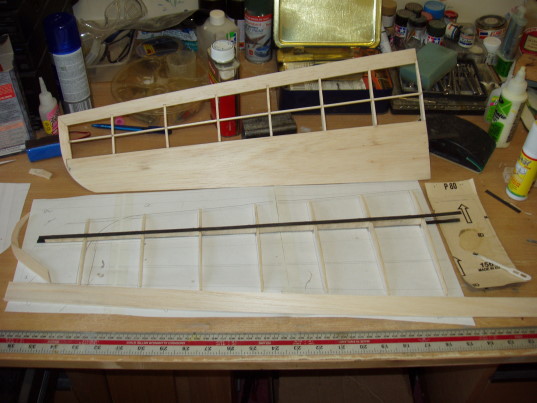
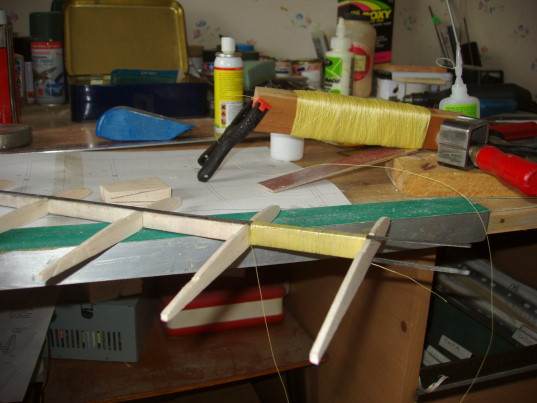
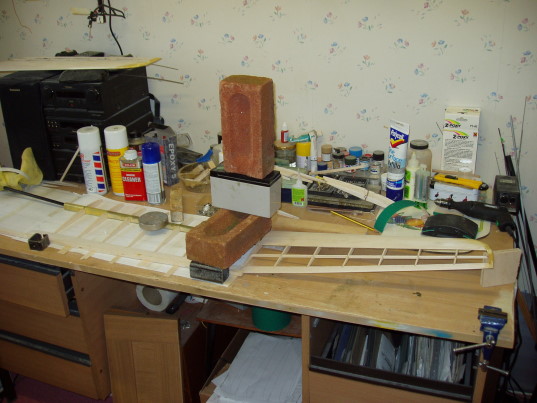
The ribs are cut from 1/8” medium balsa & the spar web from ¼” hard end grain balsa. I progressively assembled these onto the bottom carbon spar with epoxy and weighed it down with a couple of house bricks. The bottom spar has to be handled with care, as it is only .007” thick. This is not a printing error; it actually is .007” thick. The top spar is .014”; this is because carbon is much better in tension than compression. Having now got the skeleton of the panel together, before we can proceed we now have to bind the spar assembly with Kevlar thread. This is a mind-blowing job, which took a couple of hours and made my arms ache, as the thread has to be under tension whilst being applied. The whole thing is then wetted out with thinned epoxy and allowed to cure. Note the spar carry -throughs for joining to the mid panel & the five Deg set of the end rib, half the dihedral angle.
I could now add the leading & trailing edges & the 1/16” balsa covering to complete the Dee box. The leading edge shape is critical and has to be sanded to the exact angle of 18.2Deg for the top edge & 6.75Deg on the bottom before the final shaping.
The Mid Outer Panels.
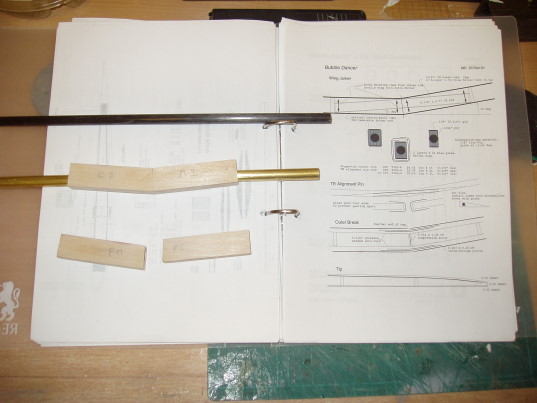
These panels are built in a similar manner to the tips, the main difference are the thicker spars, .030” tapering to .014” and the addition of the main joiner boxes. They also have 1.5 Deg of wash out built in. The joiner boxes are cut from ½” ply & have the 10.5mm joiner tube holes bored in at a five Deg angle. After a lot of head scratching I decided that the best way to tackle this is to make an oversize square block, then drill the holes and finally cut the block up into the angle required. This has to be very accurate otherwise, the dihedral angles will be wrong.
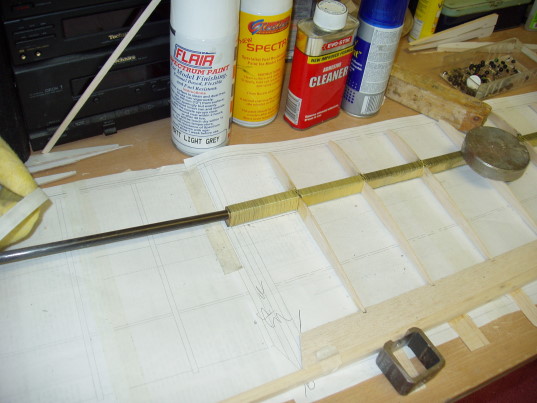
After bonding the joiner boxes to the spar they are wrapped with 2.5 Oz glass cloth, Kevlar bound & wetted out with thinned epoxy. The complete spar is then Kevlar bound.
The wing tips are added & the Kevlar binding completed. Note the amount of weight used here whilst the epoxy sets. This is the same for all the vertical spar webs, which are added one at a time and allowed to set.
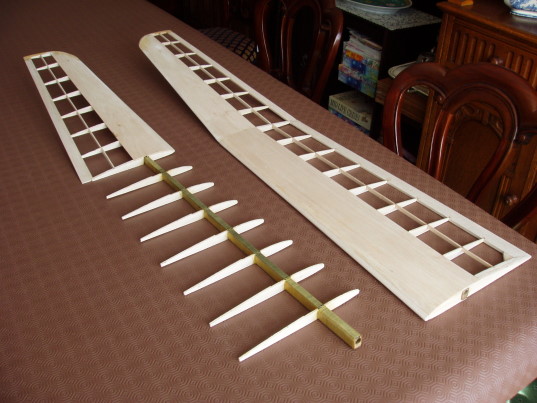
Here are one & a half outer panels. The spar binding is what it says, a real bind. The technique which I finally worked out was to hold the Kevlar spool with my feet to hold the tension in the thread whilst slowly turn the spar. The thread is only .006” thick so one bay at a time was all that I could manage before my arms gave up on me.
Having finished this the end rib is glued, ensuring that the 5deg angle is maintained. The Dee box sheeting, trailing edge & L/E are added & the L/E sanded to the finished contour. This is not easy as the section changes from the inboard end to the tip. The top tapers from 35 Deg to 31 Deg & the bottom from 20 Deg to 16 Deg. Having achieved this the section is rounded off & smoothed out to achieve the final shape.
All that is left is to build the centre section & cover the wing?
Clive |
|
|
|
|
|
[Home] [Chairman's Chatter] [Editorial] [Diary of a Flier] [Bubble Dancer 2] [BIMBO weekend] [Walkford] [Tailpiece] |